
Some time ago I posted an article titled Breath In, Breath Out. In this post I discussed how walking the way is a two-part process, much like breathing. Breathing is not inhaling or exhaling; a breath is to inhale and exhale. We need to breathe in God’s Spirit and grace and breathe out God’s love for the world. I went on to say that inhaling is best done in our quiet times with God and how important deliberate time with God is to our spiritual health.
Today I want to talk about an essential aspect of our quiet times with God. Reading His word and doing that well. In the previous article, I discussed the importance of reading broadly and deeply. Let’s look at those two aspects of inhaling a bit more closely.
Reading Broadly
When I was younger, I was extremely undisciplined in my Bible reading. I’m embarrassed to say that I would often just flip through the Bible until my eyes caught something that looked interesting and read a bit of that before I went to work. To read broadly requires being much more deliberate.
The Bible is an ancient library filled with various forms of ancient literature. There is history, law, poetry, proverbs, parables, biographies, prophetic oracles, and apocalyptic prophecy, to say nothing of the various subgenres of these categories.
Recognizing that the Bible is not a book of children’s stories is the first step in finding the motivation to explore it. Reading broadly requires a curiosity about the people, their culture, their religion, and their values. Reading broadly is reading whole books as a unit, understanding when and where they were written, and who they were written to. When we read broadly, we begin to understand context. Don’t be put off by individual troubling passages or stories. Be patient. Reading broadly is the road to reading holistically. We must learn to interpret the individual parts in the context of the whole.
How to Read Broadly
If this is new to you, and especially if you have never read the entire Bible, I highly recommend that you read each book of the Bible in historical story order. By reading the Bible in this way, you will begin to see the overarching stories and history. This gives context to everything you read thereafter.
I have included this reading list to help you on your way.
I purposely did not do a daily reading plan because, in my experience, if you miss a few days on a daily reading plan, it often leads to giving up. With a reading list, you can read as much or as little as you have time for every day. It is worth noting that the longest book in the Bible can be read out loud in 3.5 hours. So don’t be overwhelmed; read each book as a book.
If you have a study Bible that gives you any introduction to the book, read it. If you have an Archaeological Study Bible, a Bible dictionary or encyclopedia, use it to get a sense of the ancient culture that produced the book you’re reading. Yes, I know it’s inspired, but it was written by inspired ancient people from a foreign world to answer their questions long before we came along with our modern questions. We need to respect that fact and understand their world if we are to make proper use of those inspired texts in our world.
Reading Deeply
Modern translations and publishing have made the Bible more affordable, available, and approachable than at any time in the history of the world. And for that, I am profoundly thankful. More than thankful, I and the entire organization I work with have committed to getting the word of God into as many languages and places as possible as soon as possible.
But as wonderful as that is, availability is not the ultimate goal; engagement is. It is wonderful to have access to the word of God, but if you don’t take advantage of that access, it may as well not exist. The word of God gives life, much like water gives life, but only if you drink it. You can drown in water while dying of thirst. This is a sad picture but one that is more accurate than it should be.
The good news is, this problem is easy to fix. We simply need to prayerfully and intelligently read it.
So, why don’t we? There are as many reasons as there are people I suppose. But to leave our short lives without carefully examining the word of God is a completely unnecessary tragedy given our time and place.
I think it’s helpful to think about what we are really holding in our hands when we pick up a Bible. I sometimes think that if the Bible were printed on dusty, crumbling parchment, with our English translation penciled in around the ancient Hebrew, Greek, and Aramaic, we would do a better job of reading it for a couple of reasons. First we would realize what a privilege it is just to possess such a collection of rare and ancient books. It would also help us to remember that these are truly ancient and foreign books. If they were printed like this, every time we touch them, it would remind us that these books were not written to us; they were written for us. This simple fact should drive us to think about the people who wrote these books and the people and the problems they were addressing.
What were their problems, questions, and concerns?
This question is the foundation for all proper Bible reading. We all go to the word of God for help with our problems, as we should. But ironically, it is this focus on ourselves and our problems that is often the biggest hindrance to us finding the help we need in its pages. To understand the answers, we need to understand the questions these books were written to address. If we don’t understand the original intended meaning of the text, we will not know how to apply its wisdom to our issues today.
This is why reading deeply is so important. The Bible is not a children’s book, despite the fact that many of the stories are simple. The stories are simple, but not shallow. They were chosen and organized the way they are for a reason. They spoke to a people, time, and place that were very foreign to us. No matter where we live. So along with our broad reading plan, we need to read deeply and methodically to grasp the life giving message of each book.
How to Read Deeply
First, select a book you want to deeply understand. If you have never done this, I would suggest one of the gospels or the book of Ephesians or Romans.
Next, do your due diligence and study the background of the book. I would not recommend reading commentaries at this point since commentaries will skew your thinking toward the author of the commentaries opinions. The goal of all Bible study should be to let the book speak with its own voice. Instead of commentaries, use Bible dictionaries and encyclopedias. Something that will give you good historical and cultural background without telling how to interpret the text. What should you be looking for?
Date and author of the book.
An outline of the cultural and historical setting of the book.
The book’s place in the history of Israel.
This is what I would consider the basic required information before you begin to study any book in the Bible.
Once you have finished exploring the background of the book, you’re ready to do a survey reading of the book. Why do a survey reading? Because it is the most effective way I know to counteract the fragmented reading of scripture that has become so ingrained in all of us through weekly sermons and short inspirational readings in our quiet times.
A survey reading is where you read a book from start to finish as fast as you can to hear the whole message of the book in context. Reading the biblical books like an encyclopedia, or even a phone book, will never provide context or any sense of a unified message in the book.
In a survey reading, the goal is understanding the big picture, the main characters and events, and hopefully a sense of the author’s overall intention with the book.
After completing your initial survey reading, you are ready to begin to grasp the main idea and structure of the book.
Begin by creating a bullet point list of each major event, scene change, and character in the book. When complete, this should read like a very brief and concise summary of the book.
Next, read this over carefully and make any corrections necessary to clarify the message and structure of the book. This will be your road map as you continue to study the book.
Observation: What does it say?
Now you are ready to begin to make observations about what the text actually says. Begin with who, what, where, and when.
If you are reading a narrative
Compare and contrast the characters in the story. Compare and contrast characters from this story to the characters in other stories.
Look at the choices the characters made and the consequences of those choices.
If you are reading a teaching like you will find in the letters (epistles), biographies (Gospels), or in the prophets.
Look for the author’s comparisons and contrasts.
What connections is the author making?
What actions is the author (or the speaker) desiring from the audience?
If you are reading poetic language (Psalms, Proverbs, Job, Song of Songs, and large portions of the prophets)
What is the feeling the author is trying to communicate?
What is the message?
Remember poetry is often figurative and symbolic; identify the figurative, metaphorical, or symbolic elements in the poetic writings.
Making these observations will slow you down and force you to really look at what is being said before you even try to interpret what it means.
Interpretation: What did it mean to them?
I mentioned earlier that our natural focus on ourselves and our problems is one of the greatest barriers to hearing and understanding what the text is actually saying. Properly speaking, interpretation has nothing to do with us and everything to do with what it meant when it was written.
Our questions must be focused entirely on the author and his original audience.
What was the author’s intent? What did he want his audience to understand about God and/or their behavior?
What were the original reader’s questions? How did the author answer them?
What would the original readers hear in these texts?
What was the author’s desired outcome for his readers/hearers?
Application: What does this say today?
We will never truly understand what the text means to us until we understand what the author was trying to say and what the original audience would have heard.
But when we do understand that message, we can now begin to identify the timeless truths in and under that message. We are not Bronze Age goat herders, so not everything said to that audience is going to apply directly to the modern world. But the Bible is inspired by God; it is God’s word. And it is God’s word to us; it is just not God’s word directly to us. It is God’s word for us as He revealed Himself to those ancient people so long ago.
What is Timeless Truth?
A timeless truth is true regardless of the year, or place, or person. This is what we must always be on the lookout for as we read what was written so long ago. But to find these things is not the ultimate goal. The ultimate goal is embodiment. It is the application of truth.
The truth is: that which is.
Knowledge is: embodied truth.
We will know the truth as we do the truth.
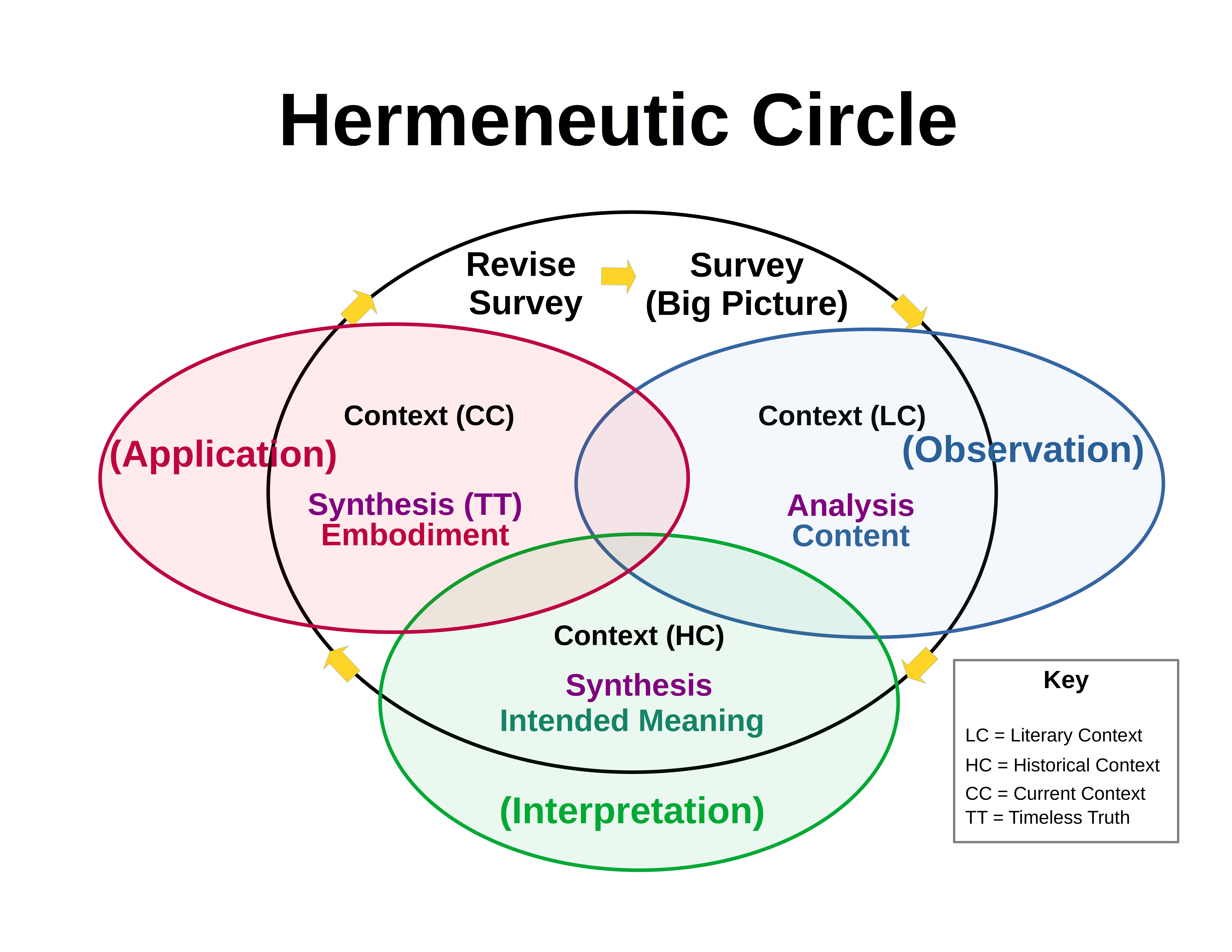
The last thing I want to say about reading deeply is that you never finish. The graphic below illustrates the method I have briefly described to you. You will notice the entire process is represented by a circle. We will never plumb the depths of God or His word. When you find questions you can’t answer, it does not necessarily mean you are doing it wrong; it may mean you are doing it right. To see God in His word is to catch a glimpse of something so great, so awe-inspiring, so incomprehensible, that wonder and worship, and yes, a bit of overwhelmed confusion, should logically be the result.
Remember:
No god small enough to fit in our head
is big enough to worship.
Have a great week!