

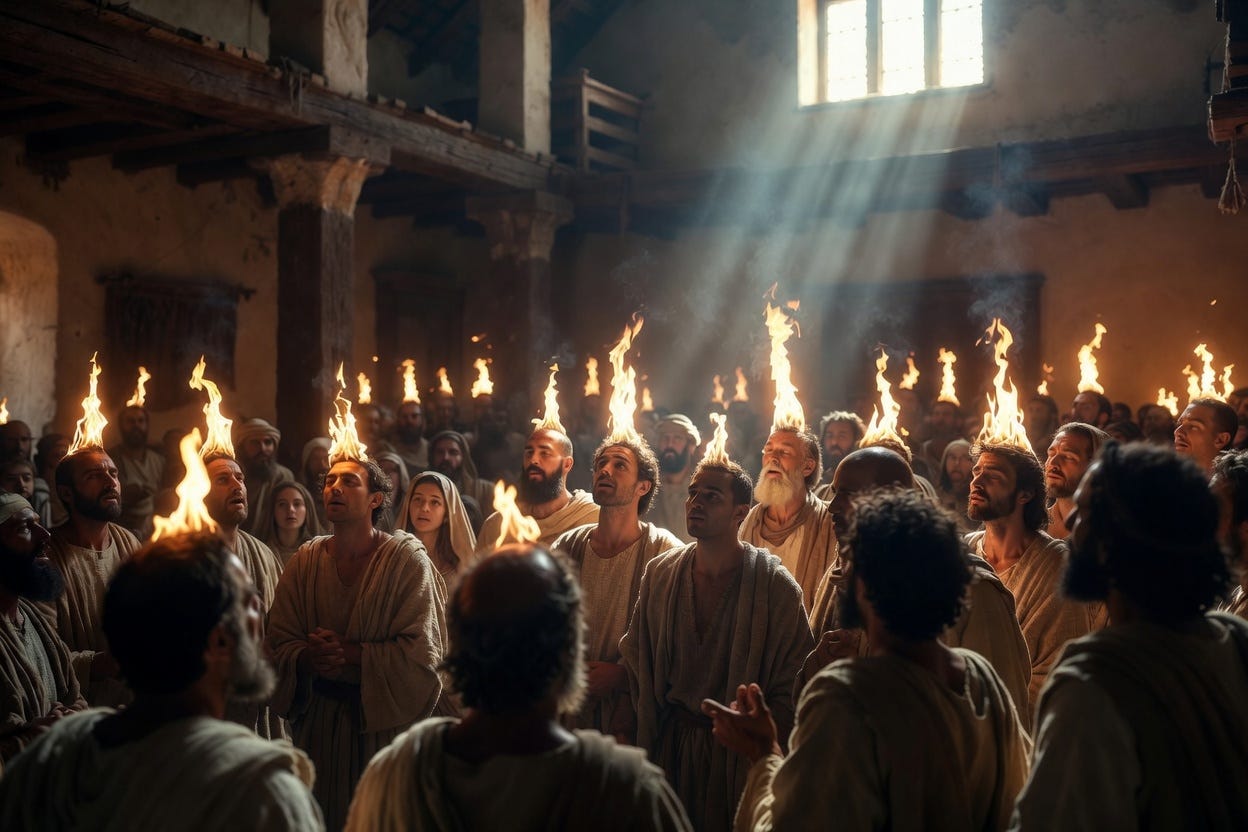
Acts 2:1–13
When the day of Pentecost arrived, they were all together in one place. And suddenly there came from heaven a sound like a mighty rushing wind, and it filled the entire house where they were sitting. And divided tongues as of fire appeared to them and rested on each one of them. And they were all filled with the Holy Spirit and began to speak in other tongues as the Spirit gave them utterance.
Now there were dwelling in Jerusalem Jews, devout men from every nation under heaven. And at this sound the multitude came together, and they were bewildered, because each one was hearing them speak in his own language. And they were amazed and astonished, saying, “Are not all these who are speaking Galileans? And how is it that we hear, each of us in his own native language? Parthians and Medes and Elamites and residents of Mesopotamia, Judea and Cappadocia, Pontus and Asia, Phrygia and Pamphylia, Egypt and the parts of Libya belonging to Cyrene, and visitors from Rome, both Jews and proselytes, Cretans and Arabians—we hear them telling in our own tongues the mighty works of God.” And all were amazed and perplexed, saying to one another, “What does this mean?” But others mocking said, “They are filled with new wine.” But Peter, standing with the eleven, lifted up his voice and addressed them: “Men of Judea and all who dwell in Jerusalem, let this be known to you, and give ear to my words. For these people are not drunk, as you suppose, since it is only the third hour of the day. But this is what was uttered through the prophet Joel: (ESV)
Message
Today is Pentecost Sunday. Pentecost or The Feast of Weeks is an ancient Jewish holiday that falls 50 days after Passover. It was one of the three required pilgrimage feasts in the Jewish calendar. But Christians also celebrate Pentecost because it is the day that the Holy Spirit fell on the original believers in that upper room in Jerusalem. It was no coincidence that Jesus was crucified on Passover and that the Holy Spirit was given at Pentecost. The symbolism for both of these events runs deep and will help us to understand both the mission of Jesus and the mission of the Church.
Context
So, to set the stage for today’s message on Pentecost, I think it would be helpful to review the exodus from Egypt. The Exodus story describes the way God freed His people from slavery in Egypt. But when we view this story through the lens of the Gospel, the exodus can be seen as both a pattern and a foreshadowing of the salvation to come through Jesus. The original exodus saved a small group of people from physical slavery. The salvation Jesus brings has the power to set the entire world free from the slavery of sin and death.
Let’s make a few comparisons to start. Moses was God’s chosen servant for Israel’s Exodus from Egypt. Jesus is God’s unique son, a new Moses, so to speak, for a new Exodus.
But Jesus is more than a new and better Moses. Jesus is also the ultimate fulfillment of the Passover lamb. His innocent blood covering the guilt and preserving the life of his people. As we continue this comparison, baptism now parallels the Red Sea crossing; it is a one-way ticket from our old life of slavery to sin to our new life in Christ. But here is where the parallel gets interesting as we consider the significance of Pentecost today. Israel did not cross the Red Sea and immediately find themselves in their inheritance in the promised land. They still had a wilderness to cross and much to learn about the God who saved them. The journey ahead was difficult but necessary.
When the Israelites arrived at Sinai, they entered a new era in their relationship with God. It was at Sinai that God appeared to them in fire and a cloud. It was there God taught them his law. And it was there that a tribal group of slaves became a people. God appeared to them in fire and gave them His law. They were equipped for the journey ahead, and on their way through the wilderness, they learned faith and grew into their identity as the people of God. God was preparing them for their destiny as they traveled through the wilderness. The wilderness was the time between their freedom from slavery and their inheritance in the promised land.
Pentecost is like the Christian Sinai. God appears in fire, and we see the people of God redefined and empowered. God was expanding His people by adding the faithful from every nation to the faithful believers of Israel. Now, God’s people are forever defined by faith, rather than ethnicity. At Sinai, God was a distant fire that most of them could not touch or even approach. At Pentecost, the fire of God’s Spirit came down to them and rested on each one. Giving each of them—and all of them together—the power to become the people of God. To become the true Body of Christ.
The Holy Spirit was now embodied in the Church. Church was now the physical manifestation of Jesus on the earth. Many theologians consider Pentecost to be the true birth of the Church. So in a sense, today is the Church’s birthday! When Jesus was physically on the earth, he could only be in one place at a time. But now, embodied in his Church through the Spirit, he could cover the earth. We are that body today!
Let’s go back to our comparison of the salvation story and the Exodus for a moment. Because I feel there is more to think about there. God was visibly present with Israel as they began their journey through the wilderness. He fed them every morning and gave them water from the dry ground. He protected them and blessed them in countless ways. At Pentecost we see this same kind of miraculous presence through the manifestation of the Holy Spirit. But where is our wilderness? And where is our promised land? These are fascinating questions to think about as we extend this comparison.
The original wilderness was a place, and it took 40 years and two generations to cross. Our wilderness is a place and a time as well. We can think of our time in the wilderness as this present age. On the other side of this present age, we have our final destination. The other side of our wilderness is also an actual physical place: the new heavens and earth, and eternal life in the presence of God in our resurrected and glorified bodies. We are now in the time between our freedom from slavery to sin and our ultimate inheritance in the new heavens and earth, which is our promised land. The new heavens and earth are a part of our ultimate inheritance. I say part because the biggest blessing of our coming inheritance is our full reunion with God himself. Paul tells us in his letter to the Ephesians that the Holy Spirit is our first taste of our ultimate inheritance. It is God dwelling in us as we face all the challenges of our journey through the wilderness of this age. Through His indwelling Spirit, we are never alone in this time between.
So, let’s sum up this comparison of the exodus of Moses and the salvation of Jesus. God sent his servant Moses, to save his people from slavery. In the case of Israel, it was physical slavery; in the case of Jesus, it was to free us from the slavery of sin and death. Figuratively speaking, Jesus is our Moses. And he is also our Passover lamb. Baptism is the beginning of our journey through the wilderness to eternal life with Jesus. And Pentecost is where God came down in the Holy Spirit to dwell in and with His people. Guiding and teaching us as we walk together through the wilderness of this age into the age to come.
But now we must return to our text for this morning. We need to remember that about 7 days before the amazing prayer meeting described in this text, Jesus commissioned his disciples to go into all the world preaching the gospel, teaching obedience, and baptizing all those who believe. You see, the gift of Pentecost was never intended for a single small group of people. From the beginning, God made it clear: this gift was for the world.
God demonstrated his commitment to the Great Commission by miraculously giving them the ability to speak in languages that they did not know on Pentecost. They glorified God in the native languages of the people from various nations gathered at Jerusalem that day. In this way, God demonstrated that the gift of Jesus was for the world, not just a small group of people in the Middle East.
The miracle of Pentecost was much bigger than a one-off miracle of language. It was a sign, and more than a sign. It was God giving the power of His Spirit to the Church. God did not simply declare that they should go into all the world and preach the gospel; he gave them the power to do it. The Church is now the body of Christ. He is the vine and we are the branches. We are the physical manifestation of Christ on the earth today. We have been given the Spirit of God to empower and guide us in our mission to this world as we journey through this present age to our ultimate inheritance.
So what do we do today?
Sadly, although the Church is now the Body of Christ, it often does not look like the Jesus we find in the Bible. Churches seem to wander off into the extremes of either “anything goes” or “nothing is right.” Following the attitudes and values of the world around us rather than Jesus. It sometimes seems we are trying to create Jesus in our image instead of the other way around. Why is this so often the case? We can quickly make the excuse that we are all broken human beings, which is true, I guess, who could deny that? But does that really take us off the hook? Did God fail to consider human frailty when he created the Church? Somehow I doubt that is an adequate answer.
We could spend a lot of time trying to analyze what is wrong with the Church. But that kind of armchair quarterbacking won’t accomplish much when we all walk out the door today. Instead, I would rather look at this from the perspective of what is possible now that the Holy Spirit has come to live in us and with us.
I think most of human history is the story of misused gifts and missed opportunities. Human beings are simply not the answer to the world’s problems; generally speaking, we are the cause of them. The Bible is clear on this point. Jesus is God’s answer. Pentecost is God taking up residence in His Church. We are the Church. God has taken up residence in us. And that is very good news. However, whenever Israel wandered outside of God’s direction in the wilderness, it led to disaster. Likewise, whenever the Church wanders from God’s direction in the wilderness of this present age, the result is the same. Disaster.
The New Testament uses the metaphor of the body of Christ for the Church, and it is an extremely powerful metaphor. Thinking about the Church in this way can be very helpful as we try to understand the significance of Pentecost. The metaphor of the Body of Christ describes us as individual members of a unified body with Christ as the head directing every move. There is a sense in which we can think of the Holy Spirit as the thing that holds the entire body together and connects it to the head. This is not a perfect image of the Holy Spirit’s role, but I think it’s helpful. In John, Jesus describes the Spirit in this way.
John 14:15–17
“If you love me, you will keep my commandments. And I will ask the Father, and he will give you another Helper, to be with you forever, even the Spirit of truth, whom the world cannot receive, because it neither sees him nor knows him. You know him, for he dwells with you and will be in you.” (ESV)
In this passage the Father, the Son, and the Spirit are purposely swirled together as one because these three are one. So the Spirit is both “another helper” that the Father was going to give them and also the one who is with them and will be in them. It is this Spirit that was given to us at Pentecost. Let that soak in. The same Spirit that raised Jesus from the dead is living inside of us today. God is dwelling inside of us, individually and together as the Church. We are empowered and guided into all that we should do by the power of God’s Spirit. The Church now has something that the world has not seen or experienced before. We have the Spirit of God living in us, and we have the gifts of the Spirit to help us.
In Ephesians 4:11–16 Paul encourages us by describing the true purpose of these gifts.
And he gave the apostles, the prophets, the evangelists, the shepherds and teachers, to equip the saints for the work of ministry, for building up the body of Christ, until we all attain to the unity of the faith and of the knowledge of the Son of God, to mature manhood, to the measure of the stature of the fullness of Christ, so that we may no longer be children, tossed to and fro by the waves and carried about by every wind of doctrine, by human cunning, by craftiness in deceitful schemes. Rather, speaking the truth in love, we are to grow up in every way into him who is the head, into Christ, from whom the whole body, joined and held together by every joint with which it is equipped, when each part is working properly, makes the body grow so that it builds itself up in love. (ESV)
In this passage Paul makes it clear that the Spirit has given gifts to the Church to equip and unify the Church. So that it is no longer tossed about by every wind of doctrine and human lies. We grow stronger as we grow together. When each member of the body is functioning as it should, it grows in love until it reaches the full stature of Christ. In other words, we will look like Jesus when each of us is using their gifts to the fullest, in unity with the rest of the body. I would like to close with a few words of advice from Paul regarding how we are to live in the Spirit. I’m reading from Romans 12.
Romans 12:4–10
For as in one body we have many members, and the members do not all have the same function, so we, though many, are one body in Christ, and individually members one of another. Having gifts that differ according to the grace given to us, let us use them: if prophecy, in proportion to our faith; if service, in our serving; the one who teaches, in his teaching; the one who exhorts, in his exhortation; the one who contributes, in generosity; the one who leads, with zeal; the one who does acts of mercy, with cheerfulness. Let love be genuine. Abhor what is evil; hold fast to what is good. Love one another with brotherly affection. Outdo one another in showing honor. (ESV)
Today, and all through this week, let’s use the gifts we have been given to love one another and build up the body of Christ. As we all travel together through this “time between” to our ultimate inheritance.
Have a great week!


